


Key Insights
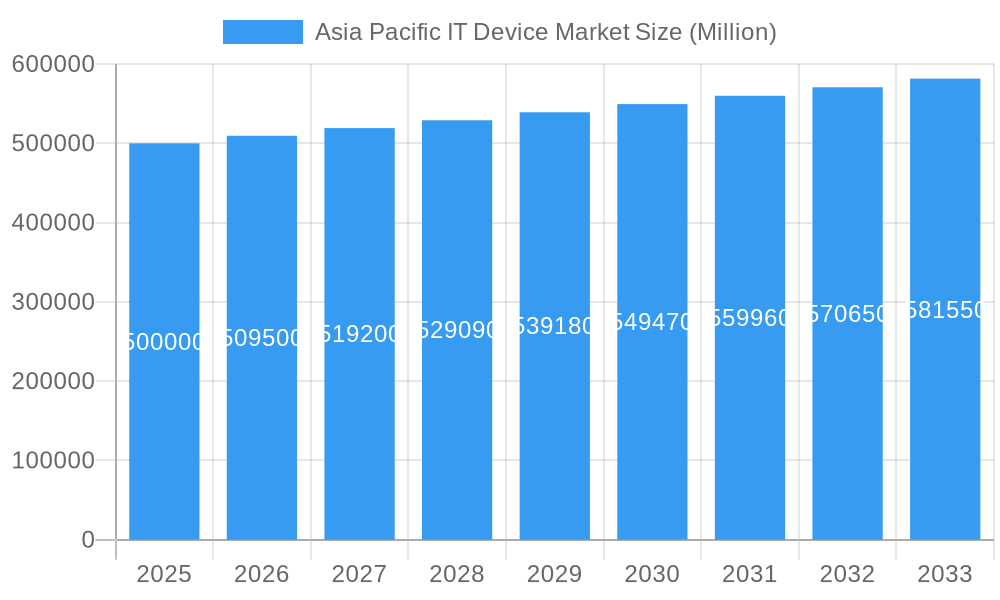
The Asia-Pacific IT device market, including PCs (laptops, desktops, tablets) and phones (smartphones, feature phones), is projected for substantial expansion. The market is estimated to reach $83.75 billion by 2025, exhibiting a Compound Annual Growth Rate (CAGR) of 34.7%. This robust growth is propelled by increasing smartphone adoption in emerging economies such as India and Indonesia, coupled with the pervasive digital transformation initiatives across the region. The rise of cloud computing and remote work further amplifies demand for laptops and tablets. Conversely, economic volatility in certain Asian economies may temper consumer spending on discretionary electronics, while smartphone market saturation in developed nations like Japan and South Korea could constrain segment-specific growth. Key market segments include Australia, China, India, Japan, and various Southeast Asian countries. Intense competition among major brands like Samsung, Apple, Xiaomi, and Huawei drives product innovation and competitive pricing, benefiting consumers across all income levels.
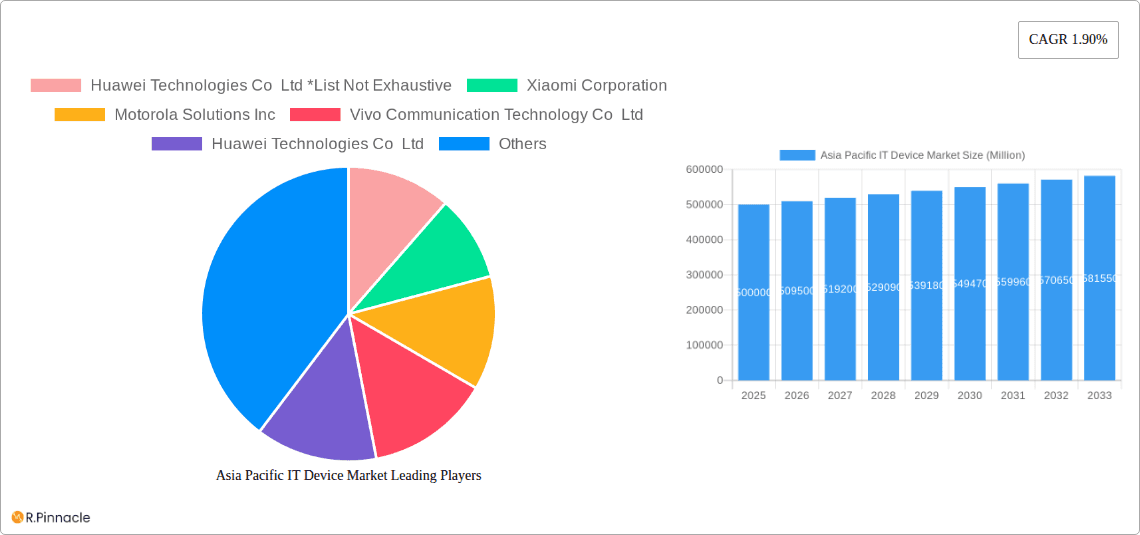
Asia Pacific IT Device Market Market Size (In Billion)

Future market dynamics will be shaped by macroeconomic trends, government policies fostering digital inclusion, and advancements in technology. The rollout of 5G networks and expanded high-speed internet access are anticipated to positively influence market expansion. Smartphones represent the largest market segment by value, with considerable growth prospects in developing economies. PCs, particularly laptops, are expected to maintain a stable market share, supported by business and educational sector demands, while the tablet segment anticipates moderate growth, influenced by regional market saturation. Given the varied economic landscapes and technology adoption rates across the Asia-Pacific, tailored strategies are essential for manufacturers to capitalize on specific market opportunities.
Asia Pacific IT Device Market Company Market Share
Asia Pacific IT Device Market Report: 2019-2033 Forecast
This comprehensive report provides a detailed analysis of the Asia Pacific IT device market, covering the period 2019-2033. It offers invaluable insights for industry professionals, investors, and strategic decision-makers seeking to understand market trends, competitive dynamics, and future growth opportunities. With a focus on PCs (laptops, desktops, tablets) and phones (landlines, smartphones, feature phones) across key Asia-Pacific nations, this report delivers actionable intelligence for informed business strategies. The base year is 2025, with estimations and forecasts extending to 2033.
Asia Pacific IT Device Market Structure & Innovation Trends
This section analyzes the market's competitive landscape, highlighting key players like Huawei Technologies Co Ltd, Xiaomi Corporation, Motorola Solutions Inc, Vivo Communication Technology Co Ltd, Google LLC, Lenovo Group Limited, ASUSTek Computer Inc, Acer Group, Guangdong Oppo Mobile Telecommunications Corp Ltd, Honor Technology Inc, Haier Group Corporation, Samsung Electronics Co Ltd, Apple Inc, Sony Corporation, LG Corporation, Microsoft Corporation, Dell Technologies, and HP Inc. (List Not Exhaustive). We delve into market concentration, exploring market share data for prominent players. Innovation drivers, including advancements in 5G, AI, and user experience are examined. Regulatory frameworks impacting the market are also discussed, along with an analysis of product substitutes and their market penetration. Furthermore, the report investigates end-user demographics and the impact of M&A activities, including deal values (xx Million) and their influence on market consolidation. The analysis includes a thorough examination of the historical period (2019-2024) to establish a strong foundation for the future projections.
Asia Pacific IT Device Market Dynamics & Trends
This section explores the market's growth drivers, technological disruptions, evolving consumer preferences, and competitive dynamics. We analyze the Compound Annual Growth Rate (CAGR) for the forecast period (2025-2033), projecting a xx% growth. Market penetration rates for various IT device types across different countries are assessed. We will detail the impact of technological advancements like 5G and AI on market growth, the shifting consumer preferences toward specific device features and brands, and the competitive strategies employed by leading players. The influence of economic factors, including disposable income and purchasing power parity, on market demand is also considered. An in-depth analysis of the market size (xx Million) across various segments will be presented.
Dominant Regions & Segments in Asia Pacific IT Device Market
This section identifies the dominant regions and segments within the Asia Pacific IT device market. We analyze the market performance across various geographic locations, including Australia, China, India, Japan, Indonesia, Malaysia, Singapore, South Korea, Taiwan, Thailand, and the Rest of Asia-Pacific. Key drivers for each region's dominance are examined using bullet points:
- China: Strong domestic manufacturing base, large population, rising disposable income.
- India: Rapidly growing smartphone market, increasing internet penetration.
- Japan: High technological advancement, strong consumer electronics market.
- South Korea: Innovation hub, leading manufacturers.
The analysis will extend to individual device types (PCs and Phones), examining the market share and growth trajectory of laptops, desktops, tablets, landline phones, smartphones, and feature phones. The report will provide a detailed explanation of the factors contributing to the dominance of each leading region and segment, considering factors like economic policies, infrastructure development, and consumer behavior.
Asia Pacific IT Device Market Product Innovations
This section summarizes recent product developments, highlighting technological advancements and their market impact. We analyze the competitive advantages offered by new products and the integration of emerging technologies like AI and 5G. The analysis will specifically address how innovations in features, design, and performance drive market acceptance.
Report Scope & Segmentation Analysis
This report segments the Asia Pacific IT device market based on device type (PCs: Laptops, Desktop PCs, Tablets; Phones: Landline Phones, Smartphones, Feature Phones) and geography (Australia, China, India, Japan, Indonesia, Malaysia, Singapore, South Korea, Taiwan, Thailand, Rest of Asia-Pacific). Each segment’s market size (xx Million), growth projections, and competitive dynamics are thoroughly analyzed. Specific market size and growth rate data are provided for each segment.
Key Drivers of Asia Pacific IT Device Market Growth
This section highlights the primary growth drivers influencing the Asia Pacific IT device market. We explore technological advancements (e.g., 5G, AI), economic factors (e.g., rising disposable incomes, increasing urbanization), and supportive government policies (e.g., digital India initiatives). Specific examples and their quantifiable impacts on market growth are provided.
Challenges in the Asia Pacific IT Device Market Sector
This section addresses significant challenges impacting market growth, including regulatory hurdles (e.g., data privacy regulations), supply chain disruptions (e.g., component shortages), and intensifying competition (e.g., price wars, patent disputes). The quantifiable impacts of these challenges on market growth are included.
Emerging Opportunities in Asia Pacific IT Device Market
This section identifies emerging trends and opportunities for growth, including the expansion into new markets (e.g., rural areas), the adoption of new technologies (e.g., IoT, foldable devices), and shifting consumer preferences (e.g., demand for sustainable products).
Leading Players in the Asia Pacific IT Device Market Market
- Huawei Technologies Co Ltd
- Xiaomi Corporation
- Motorola Solutions Inc
- Vivo Communication Technology Co Ltd
- Google LLC
- Lenovo Group Limited
- ASUSTek Computer Inc
- Acer Group
- Guangdong Oppo Mobile Telecommunications Corp Ltd
- Honor Technology Inc
- Haier Group Corporation
- Samsung Electronics Co Ltd
- Apple Inc
- Sony Corporation
- LG Corporation
- Microsoft Corporation
- Dell Technologies
- HP Inc
Key Developments in Asia Pacific IT Device Market Industry
- June 2022: Huawei introduced new technologies transforming AI, 5G, and user experience, including a game-changing "optical iris" and an adder neural network. This development is expected to significantly improve network efficiency and reduce broadband rollout costs.
- July 2022: Samsung Electronics launched Samsung Newsroom Singapore, enhancing its presence in Southeast Asia and improving communication with regional media and consumers. This is expected to positively impact brand perception and sales in the region.
Future Outlook for Asia Pacific IT Device Market Market
The Asia Pacific IT device market is poised for continued growth, driven by factors such as increasing smartphone penetration, rising disposable incomes, and the growing adoption of advanced technologies. Strategic opportunities exist for companies focusing on innovation, affordability, and customer experience. The market is expected to maintain strong growth, presenting significant potential for market participants who can adapt to evolving consumer demands and technological advancements.
Asia Pacific IT Device Market Segmentation
-
1. Type
-
1.1. PC's
- 1.1.1. Laptops
- 1.1.2. Desktop PCs
- 1.1.3. Tablets
-
1.2. Phones
- 1.2.1. Landline Phones
- 1.2.2. Smartphones
- 1.2.3. Feature Phones
-
1.1. PC's
-
2. Geography
- 2.1. Australia
- 2.2. China
- 2.3. India
- 2.4. Japan
- 2.5. Indonesia
- 2.6. Malaysia
- 2.7. Singapore
- 2.8. South Korea
- 2.9. Taiwan
- 2.10. Thailand
- 2.11. Rest of Asia-pacific
Asia Pacific IT Device Market Segmentation By Geography
- 1. Australia
- 2. China
- 3. India
- 4. Japan
- 5. Indonesia
- 6. Malaysia
- 7. Singapore
- 8. South Korea
- 9. Taiwan
- 10. Thailand
- 11. Rest of Asia pacific
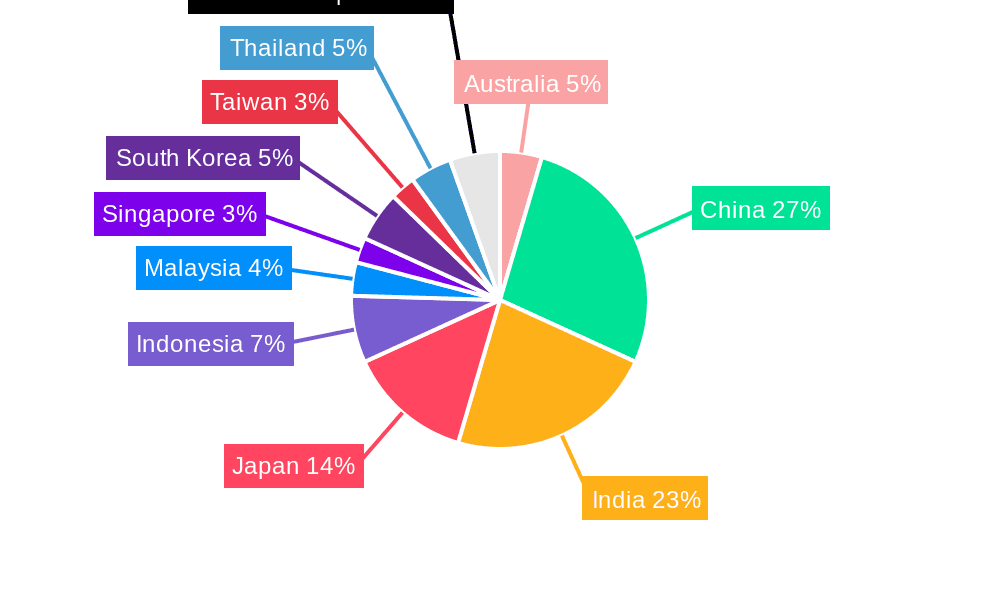
Asia Pacific IT Device Market Regional Market Share
Geographic Coverage of Asia Pacific IT Device Market
Asia Pacific IT Device Market REPORT HIGHLIGHTS
| Aspects | Details |
|---|---|
| Study Period | 2020-2034 |
| Base Year | 2025 |
| Estimated Year | 2026 |
| Forecast Period | 2026-2034 |
| Historical Period | 2020-2025 |
| Growth Rate | CAGR of 34.7% from 2020-2034 |
| Segmentation |
|
Table of Contents
- 1. Introduction
- 1.1. Research Scope
- 1.2. Market Segmentation
- 1.3. Research Methodology
- 1.4. Definitions and Assumptions
- 2. Executive Summary
- 2.1. Introduction
- 3. Market Dynamics
- 3.1. Introduction
- 3.2. Market Drivers
- 3.2.1. Rising Demand of 5G Enabled Smartphones; Robust Technological Presence in China
- 3.3. Market Restrains
- 3.3.1. Supply Chain Disruption Owing to COVID-19
- 3.4. Market Trends
- 3.4.1. Robust Demand for Smart Phones
- 4. Market Factor Analysis
- 4.1. Porters Five Forces
- 4.2. Supply/Value Chain
- 4.3. PESTEL analysis
- 4.4. Market Entropy
- 4.5. Patent/Trademark Analysis
- 5. Asia Pacific IT Device Market Analysis, Insights and Forecast, 2020-2032
- 5.1. Market Analysis, Insights and Forecast - by Type
- 5.1.1. PC's
- 5.1.1.1. Laptops
- 5.1.1.2. Desktop PCs
- 5.1.1.3. Tablets
- 5.1.2. Phones
- 5.1.2.1. Landline Phones
- 5.1.2.2. Smartphones
- 5.1.2.3. Feature Phones
- 5.1.1. PC's
- 5.2. Market Analysis, Insights and Forecast - by Geography
- 5.2.1. Australia
- 5.2.2. China
- 5.2.3. India
- 5.2.4. Japan
- 5.2.5. Indonesia
- 5.2.6. Malaysia
- 5.2.7. Singapore
- 5.2.8. South Korea
- 5.2.9. Taiwan
- 5.2.10. Thailand
- 5.2.11. Rest of Asia-pacific
- 5.3. Market Analysis, Insights and Forecast - by Region
- 5.3.1. Australia
- 5.3.2. China
- 5.3.3. India
- 5.3.4. Japan
- 5.3.5. Indonesia
- 5.3.6. Malaysia
- 5.3.7. Singapore
- 5.3.8. South Korea
- 5.3.9. Taiwan
- 5.3.10. Thailand
- 5.3.11. Rest of Asia pacific
- 5.1. Market Analysis, Insights and Forecast - by Type
- 6. Australia Asia Pacific IT Device Market Analysis, Insights and Forecast, 2020-2032
- 6.1. Market Analysis, Insights and Forecast - by Type
- 6.1.1. PC's
- 6.1.1.1. Laptops
- 6.1.1.2. Desktop PCs
- 6.1.1.3. Tablets
- 6.1.2. Phones
- 6.1.2.1. Landline Phones
- 6.1.2.2. Smartphones
- 6.1.2.3. Feature Phones
- 6.1.1. PC's
- 6.2. Market Analysis, Insights and Forecast - by Geography
- 6.2.1. Australia
- 6.2.2. China
- 6.2.3. India
- 6.2.4. Japan
- 6.2.5. Indonesia
- 6.2.6. Malaysia
- 6.2.7. Singapore
- 6.2.8. South Korea
- 6.2.9. Taiwan
- 6.2.10. Thailand
- 6.2.11. Rest of Asia-pacific
- 6.1. Market Analysis, Insights and Forecast - by Type
- 7. China Asia Pacific IT Device Market Analysis, Insights and Forecast, 2020-2032
- 7.1. Market Analysis, Insights and Forecast - by Type
- 7.1.1. PC's
- 7.1.1.1. Laptops
- 7.1.1.2. Desktop PCs
- 7.1.1.3. Tablets
- 7.1.2. Phones
- 7.1.2.1. Landline Phones
- 7.1.2.2. Smartphones
- 7.1.2.3. Feature Phones
- 7.1.1. PC's
- 7.2. Market Analysis, Insights and Forecast - by Geography
- 7.2.1. Australia
- 7.2.2. China
- 7.2.3. India
- 7.2.4. Japan
- 7.2.5. Indonesia
- 7.2.6. Malaysia
- 7.2.7. Singapore
- 7.2.8. South Korea
- 7.2.9. Taiwan
- 7.2.10. Thailand
- 7.2.11. Rest of Asia-pacific
- 7.1. Market Analysis, Insights and Forecast - by Type
- 8. India Asia Pacific IT Device Market Analysis, Insights and Forecast, 2020-2032
- 8.1. Market Analysis, Insights and Forecast - by Type
- 8.1.1. PC's
- 8.1.1.1. Laptops
- 8.1.1.2. Desktop PCs
- 8.1.1.3. Tablets
- 8.1.2. Phones
- 8.1.2.1. Landline Phones
- 8.1.2.2. Smartphones
- 8.1.2.3. Feature Phones
- 8.1.1. PC's
- 8.2. Market Analysis, Insights and Forecast - by Geography
- 8.2.1. Australia
- 8.2.2. China
- 8.2.3. India
- 8.2.4. Japan
- 8.2.5. Indonesia
- 8.2.6. Malaysia
- 8.2.7. Singapore
- 8.2.8. South Korea
- 8.2.9. Taiwan
- 8.2.10. Thailand
- 8.2.11. Rest of Asia-pacific
- 8.1. Market Analysis, Insights and Forecast - by Type
- 9. Japan Asia Pacific IT Device Market Analysis, Insights and Forecast, 2020-2032
- 9.1. Market Analysis, Insights and Forecast - by Type
- 9.1.1. PC's
- 9.1.1.1. Laptops
- 9.1.1.2. Desktop PCs
- 9.1.1.3. Tablets
- 9.1.2. Phones
- 9.1.2.1. Landline Phones
- 9.1.2.2. Smartphones
- 9.1.2.3. Feature Phones
- 9.1.1. PC's
- 9.2. Market Analysis, Insights and Forecast - by Geography
- 9.2.1. Australia
- 9.2.2. China
- 9.2.3. India
- 9.2.4. Japan
- 9.2.5. Indonesia
- 9.2.6. Malaysia
- 9.2.7. Singapore
- 9.2.8. South Korea
- 9.2.9. Taiwan
- 9.2.10. Thailand
- 9.2.11. Rest of Asia-pacific
- 9.1. Market Analysis, Insights and Forecast - by Type
- 10. Indonesia Asia Pacific IT Device Market Analysis, Insights and Forecast, 2020-2032
- 10.1. Market Analysis, Insights and Forecast - by Type
- 10.1.1. PC's
- 10.1.1.1. Laptops
- 10.1.1.2. Desktop PCs
- 10.1.1.3. Tablets
- 10.1.2. Phones
- 10.1.2.1. Landline Phones
- 10.1.2.2. Smartphones
- 10.1.2.3. Feature Phones
- 10.1.1. PC's
- 10.2. Market Analysis, Insights and Forecast - by Geography
- 10.2.1. Australia
- 10.2.2. China
- 10.2.3. India
- 10.2.4. Japan
- 10.2.5. Indonesia
- 10.2.6. Malaysia
- 10.2.7. Singapore
- 10.2.8. South Korea
- 10.2.9. Taiwan
- 10.2.10. Thailand
- 10.2.11. Rest of Asia-pacific
- 10.1. Market Analysis, Insights and Forecast - by Type
- 11. Malaysia Asia Pacific IT Device Market Analysis, Insights and Forecast, 2020-2032
- 11.1. Market Analysis, Insights and Forecast - by Type
- 11.1.1. PC's
- 11.1.1.1. Laptops
- 11.1.1.2. Desktop PCs
- 11.1.1.3. Tablets
- 11.1.2. Phones
- 11.1.2.1. Landline Phones
- 11.1.2.2. Smartphones
- 11.1.2.3. Feature Phones
- 11.1.1. PC's
- 11.2. Market Analysis, Insights and Forecast - by Geography
- 11.2.1. Australia
- 11.2.2. China
- 11.2.3. India
- 11.2.4. Japan
- 11.2.5. Indonesia
- 11.2.6. Malaysia
- 11.2.7. Singapore
- 11.2.8. South Korea
- 11.2.9. Taiwan
- 11.2.10. Thailand
- 11.2.11. Rest of Asia-pacific
- 11.1. Market Analysis, Insights and Forecast - by Type
- 12. Singapore Asia Pacific IT Device Market Analysis, Insights and Forecast, 2020-2032
- 12.1. Market Analysis, Insights and Forecast - by Type
- 12.1.1. PC's
- 12.1.1.1. Laptops
- 12.1.1.2. Desktop PCs
- 12.1.1.3. Tablets
- 12.1.2. Phones
- 12.1.2.1. Landline Phones
- 12.1.2.2. Smartphones
- 12.1.2.3. Feature Phones
- 12.1.1. PC's
- 12.2. Market Analysis, Insights and Forecast - by Geography
- 12.2.1. Australia
- 12.2.2. China
- 12.2.3. India
- 12.2.4. Japan
- 12.2.5. Indonesia
- 12.2.6. Malaysia
- 12.2.7. Singapore
- 12.2.8. South Korea
- 12.2.9. Taiwan
- 12.2.10. Thailand
- 12.2.11. Rest of Asia-pacific
- 12.1. Market Analysis, Insights and Forecast - by Type
- 13. South Korea Asia Pacific IT Device Market Analysis, Insights and Forecast, 2020-2032
- 13.1. Market Analysis, Insights and Forecast - by Type
- 13.1.1. PC's
- 13.1.1.1. Laptops
- 13.1.1.2. Desktop PCs
- 13.1.1.3. Tablets
- 13.1.2. Phones
- 13.1.2.1. Landline Phones
- 13.1.2.2. Smartphones
- 13.1.2.3. Feature Phones
- 13.1.1. PC's
- 13.2. Market Analysis, Insights and Forecast - by Geography
- 13.2.1. Australia
- 13.2.2. China
- 13.2.3. India
- 13.2.4. Japan
- 13.2.5. Indonesia
- 13.2.6. Malaysia
- 13.2.7. Singapore
- 13.2.8. South Korea
- 13.2.9. Taiwan
- 13.2.10. Thailand
- 13.2.11. Rest of Asia-pacific
- 13.1. Market Analysis, Insights and Forecast - by Type
- 14. Taiwan Asia Pacific IT Device Market Analysis, Insights and Forecast, 2020-2032
- 14.1. Market Analysis, Insights and Forecast - by Type
- 14.1.1. PC's
- 14.1.1.1. Laptops
- 14.1.1.2. Desktop PCs
- 14.1.1.3. Tablets
- 14.1.2. Phones
- 14.1.2.1. Landline Phones
- 14.1.2.2. Smartphones
- 14.1.2.3. Feature Phones
- 14.1.1. PC's
- 14.2. Market Analysis, Insights and Forecast - by Geography
- 14.2.1. Australia
- 14.2.2. China
- 14.2.3. India
- 14.2.4. Japan
- 14.2.5. Indonesia
- 14.2.6. Malaysia
- 14.2.7. Singapore
- 14.2.8. South Korea
- 14.2.9. Taiwan
- 14.2.10. Thailand
- 14.2.11. Rest of Asia-pacific
- 14.1. Market Analysis, Insights and Forecast - by Type
- 15. Thailand Asia Pacific IT Device Market Analysis, Insights and Forecast, 2020-2032
- 15.1. Market Analysis, Insights and Forecast - by Type
- 15.1.1. PC's
- 15.1.1.1. Laptops
- 15.1.1.2. Desktop PCs
- 15.1.1.3. Tablets
- 15.1.2. Phones
- 15.1.2.1. Landline Phones
- 15.1.2.2. Smartphones
- 15.1.2.3. Feature Phones
- 15.1.1. PC's
- 15.2. Market Analysis, Insights and Forecast - by Geography
- 15.2.1. Australia
- 15.2.2. China
- 15.2.3. India
- 15.2.4. Japan
- 15.2.5. Indonesia
- 15.2.6. Malaysia
- 15.2.7. Singapore
- 15.2.8. South Korea
- 15.2.9. Taiwan
- 15.2.10. Thailand
- 15.2.11. Rest of Asia-pacific
- 15.1. Market Analysis, Insights and Forecast - by Type
- 16. Rest of Asia pacific Asia Pacific IT Device Market Analysis, Insights and Forecast, 2020-2032
- 16.1. Market Analysis, Insights and Forecast - by Type
- 16.1.1. PC's
- 16.1.1.1. Laptops
- 16.1.1.2. Desktop PCs
- 16.1.1.3. Tablets
- 16.1.2. Phones
- 16.1.2.1. Landline Phones
- 16.1.2.2. Smartphones
- 16.1.2.3. Feature Phones
- 16.1.1. PC's
- 16.2. Market Analysis, Insights and Forecast - by Geography
- 16.2.1. Australia
- 16.2.2. China
- 16.2.3. India
- 16.2.4. Japan
- 16.2.5. Indonesia
- 16.2.6. Malaysia
- 16.2.7. Singapore
- 16.2.8. South Korea
- 16.2.9. Taiwan
- 16.2.10. Thailand
- 16.2.11. Rest of Asia-pacific
- 16.1. Market Analysis, Insights and Forecast - by Type
- 17. Competitive Analysis
- 17.1. Market Share Analysis 2025
- 17.2. Company Profiles
- 17.2.1 Huawei Technologies Co Ltd *List Not Exhaustive
- 17.2.1.1. Overview
- 17.2.1.2. Products
- 17.2.1.3. SWOT Analysis
- 17.2.1.4. Recent Developments
- 17.2.1.5. Financials (Based on Availability)
- 17.2.2 Xiaomi Corporation
- 17.2.2.1. Overview
- 17.2.2.2. Products
- 17.2.2.3. SWOT Analysis
- 17.2.2.4. Recent Developments
- 17.2.2.5. Financials (Based on Availability)
- 17.2.3 Motorola Solutions Inc
- 17.2.3.1. Overview
- 17.2.3.2. Products
- 17.2.3.3. SWOT Analysis
- 17.2.3.4. Recent Developments
- 17.2.3.5. Financials (Based on Availability)
- 17.2.4 Vivo Communication Technology Co Ltd
- 17.2.4.1. Overview
- 17.2.4.2. Products
- 17.2.4.3. SWOT Analysis
- 17.2.4.4. Recent Developments
- 17.2.4.5. Financials (Based on Availability)
- 17.2.5 Huawei Technologies Co Ltd
- 17.2.5.1. Overview
- 17.2.5.2. Products
- 17.2.5.3. SWOT Analysis
- 17.2.5.4. Recent Developments
- 17.2.5.5. Financials (Based on Availability)
- 17.2.6 Google LLC
- 17.2.6.1. Overview
- 17.2.6.2. Products
- 17.2.6.3. SWOT Analysis
- 17.2.6.4. Recent Developments
- 17.2.6.5. Financials (Based on Availability)
- 17.2.7 Lenovo Group Limited
- 17.2.7.1. Overview
- 17.2.7.2. Products
- 17.2.7.3. SWOT Analysis
- 17.2.7.4. Recent Developments
- 17.2.7.5. Financials (Based on Availability)
- 17.2.8 ASUSTek Computer Inc
- 17.2.8.1. Overview
- 17.2.8.2. Products
- 17.2.8.3. SWOT Analysis
- 17.2.8.4. Recent Developments
- 17.2.8.5. Financials (Based on Availability)
- 17.2.9 Acer Group
- 17.2.9.1. Overview
- 17.2.9.2. Products
- 17.2.9.3. SWOT Analysis
- 17.2.9.4. Recent Developments
- 17.2.9.5. Financials (Based on Availability)
- 17.2.10 Guangdong Oppo Mobile Telecommunications Corp Ltd
- 17.2.10.1. Overview
- 17.2.10.2. Products
- 17.2.10.3. SWOT Analysis
- 17.2.10.4. Recent Developments
- 17.2.10.5. Financials (Based on Availability)
- 17.2.11 Honor Technology Inc
- 17.2.11.1. Overview
- 17.2.11.2. Products
- 17.2.11.3. SWOT Analysis
- 17.2.11.4. Recent Developments
- 17.2.11.5. Financials (Based on Availability)
- 17.2.12 Haier Group Corporation
- 17.2.12.1. Overview
- 17.2.12.2. Products
- 17.2.12.3. SWOT Analysis
- 17.2.12.4. Recent Developments
- 17.2.12.5. Financials (Based on Availability)
- 17.2.13 Samsung Electronics Co Ltd
- 17.2.13.1. Overview
- 17.2.13.2. Products
- 17.2.13.3. SWOT Analysis
- 17.2.13.4. Recent Developments
- 17.2.13.5. Financials (Based on Availability)
- 17.2.14 Apple Inc
- 17.2.14.1. Overview
- 17.2.14.2. Products
- 17.2.14.3. SWOT Analysis
- 17.2.14.4. Recent Developments
- 17.2.14.5. Financials (Based on Availability)
- 17.2.15 Sony Corporation
- 17.2.15.1. Overview
- 17.2.15.2. Products
- 17.2.15.3. SWOT Analysis
- 17.2.15.4. Recent Developments
- 17.2.15.5. Financials (Based on Availability)
- 17.2.16 LG Corporation
- 17.2.16.1. Overview
- 17.2.16.2. Products
- 17.2.16.3. SWOT Analysis
- 17.2.16.4. Recent Developments
- 17.2.16.5. Financials (Based on Availability)
- 17.2.17 Microsoft Corporation
- 17.2.17.1. Overview
- 17.2.17.2. Products
- 17.2.17.3. SWOT Analysis
- 17.2.17.4. Recent Developments
- 17.2.17.5. Financials (Based on Availability)
- 17.2.18 Dell Technologies
- 17.2.18.1. Overview
- 17.2.18.2. Products
- 17.2.18.3. SWOT Analysis
- 17.2.18.4. Recent Developments
- 17.2.18.5. Financials (Based on Availability)
- 17.2.19 HP Inc
- 17.2.19.1. Overview
- 17.2.19.2. Products
- 17.2.19.3. SWOT Analysis
- 17.2.19.4. Recent Developments
- 17.2.19.5. Financials (Based on Availability)
- 17.2.1 Huawei Technologies Co Ltd *List Not Exhaustive
List of Figures
- Figure 1: Asia Pacific IT Device Market Revenue Breakdown (billion, %) by Product 2025 & 2033
- Figure 2: Asia Pacific IT Device Market Share (%) by Company 2025
List of Tables
- Table 1: Asia Pacific IT Device Market Revenue billion Forecast, by Type 2020 & 2033
- Table 2: Asia Pacific IT Device Market Revenue billion Forecast, by Geography 2020 & 2033
- Table 3: Asia Pacific IT Device Market Revenue billion Forecast, by Region 2020 & 2033
- Table 4: Asia Pacific IT Device Market Revenue billion Forecast, by Type 2020 & 2033
- Table 5: Asia Pacific IT Device Market Revenue billion Forecast, by Geography 2020 & 2033
- Table 6: Asia Pacific IT Device Market Revenue billion Forecast, by Country 2020 & 2033
- Table 7: Asia Pacific IT Device Market Revenue billion Forecast, by Type 2020 & 2033
- Table 8: Asia Pacific IT Device Market Revenue billion Forecast, by Geography 2020 & 2033
- Table 9: Asia Pacific IT Device Market Revenue billion Forecast, by Country 2020 & 2033
- Table 10: Asia Pacific IT Device Market Revenue billion Forecast, by Type 2020 & 2033
- Table 11: Asia Pacific IT Device Market Revenue billion Forecast, by Geography 2020 & 2033
- Table 12: Asia Pacific IT Device Market Revenue billion Forecast, by Country 2020 & 2033
- Table 13: Asia Pacific IT Device Market Revenue billion Forecast, by Type 2020 & 2033
- Table 14: Asia Pacific IT Device Market Revenue billion Forecast, by Geography 2020 & 2033
- Table 15: Asia Pacific IT Device Market Revenue billion Forecast, by Country 2020 & 2033
- Table 16: Asia Pacific IT Device Market Revenue billion Forecast, by Type 2020 & 2033
- Table 17: Asia Pacific IT Device Market Revenue billion Forecast, by Geography 2020 & 2033
- Table 18: Asia Pacific IT Device Market Revenue billion Forecast, by Country 2020 & 2033
- Table 19: Asia Pacific IT Device Market Revenue billion Forecast, by Type 2020 & 2033
- Table 20: Asia Pacific IT Device Market Revenue billion Forecast, by Geography 2020 & 2033
- Table 21: Asia Pacific IT Device Market Revenue billion Forecast, by Country 2020 & 2033
- Table 22: Asia Pacific IT Device Market Revenue billion Forecast, by Type 2020 & 2033
- Table 23: Asia Pacific IT Device Market Revenue billion Forecast, by Geography 2020 & 2033
- Table 24: Asia Pacific IT Device Market Revenue billion Forecast, by Country 2020 & 2033
- Table 25: Asia Pacific IT Device Market Revenue billion Forecast, by Type 2020 & 2033
- Table 26: Asia Pacific IT Device Market Revenue billion Forecast, by Geography 2020 & 2033
- Table 27: Asia Pacific IT Device Market Revenue billion Forecast, by Country 2020 & 2033
- Table 28: Asia Pacific IT Device Market Revenue billion Forecast, by Type 2020 & 2033
- Table 29: Asia Pacific IT Device Market Revenue billion Forecast, by Geography 2020 & 2033
- Table 30: Asia Pacific IT Device Market Revenue billion Forecast, by Country 2020 & 2033
- Table 31: Asia Pacific IT Device Market Revenue billion Forecast, by Type 2020 & 2033
- Table 32: Asia Pacific IT Device Market Revenue billion Forecast, by Geography 2020 & 2033
- Table 33: Asia Pacific IT Device Market Revenue billion Forecast, by Country 2020 & 2033
- Table 34: Asia Pacific IT Device Market Revenue billion Forecast, by Type 2020 & 2033
- Table 35: Asia Pacific IT Device Market Revenue billion Forecast, by Geography 2020 & 2033
- Table 36: Asia Pacific IT Device Market Revenue billion Forecast, by Country 2020 & 2033
Frequently Asked Questions
1. What is the projected Compound Annual Growth Rate (CAGR) of the Asia Pacific IT Device Market?
The projected CAGR is approximately 34.7%.
2. Which companies are prominent players in the Asia Pacific IT Device Market?
Key companies in the market include Huawei Technologies Co Ltd *List Not Exhaustive, Xiaomi Corporation, Motorola Solutions Inc, Vivo Communication Technology Co Ltd, Huawei Technologies Co Ltd, Google LLC, Lenovo Group Limited, ASUSTek Computer Inc, Acer Group, Guangdong Oppo Mobile Telecommunications Corp Ltd, Honor Technology Inc, Haier Group Corporation, Samsung Electronics Co Ltd, Apple Inc, Sony Corporation, LG Corporation, Microsoft Corporation, Dell Technologies, HP Inc.
3. What are the main segments of the Asia Pacific IT Device Market?
The market segments include Type, Geography.
4. Can you provide details about the market size?
The market size is estimated to be USD 83.75 billion as of 2022.
5. What are some drivers contributing to market growth?
Rising Demand of 5G Enabled Smartphones; Robust Technological Presence in China.
6. What are the notable trends driving market growth?
Robust Demand for Smart Phones.
7. Are there any restraints impacting market growth?
Supply Chain Disruption Owing to COVID-19.
8. Can you provide examples of recent developments in the market?
July 2022: Samsung Electronics, the leading telephone brand in the world, announced the launch of Samsung Newsroom Singapore. The Samsung Newsroom in Southeast Asia, located in Singapore, would offer various information, including press releases, live broadcasts of local and international Samsung events, and high-quality photos and videos.
9. What pricing options are available for accessing the report?
Pricing options include single-user, multi-user, and enterprise licenses priced at USD 4750, USD 5250, and USD 8750 respectively.
10. Is the market size provided in terms of value or volume?
The market size is provided in terms of value, measured in billion.
11. Are there any specific market keywords associated with the report?
Yes, the market keyword associated with the report is "Asia Pacific IT Device Market," which aids in identifying and referencing the specific market segment covered.
12. How do I determine which pricing option suits my needs best?
The pricing options vary based on user requirements and access needs. Individual users may opt for single-user licenses, while businesses requiring broader access may choose multi-user or enterprise licenses for cost-effective access to the report.
13. Are there any additional resources or data provided in the Asia Pacific IT Device Market report?
While the report offers comprehensive insights, it's advisable to review the specific contents or supplementary materials provided to ascertain if additional resources or data are available.
14. How can I stay updated on further developments or reports in the Asia Pacific IT Device Market?
To stay informed about further developments, trends, and reports in the Asia Pacific IT Device Market, consider subscribing to industry newsletters, following relevant companies and organizations, or regularly checking reputable industry news sources and publications.
Methodology
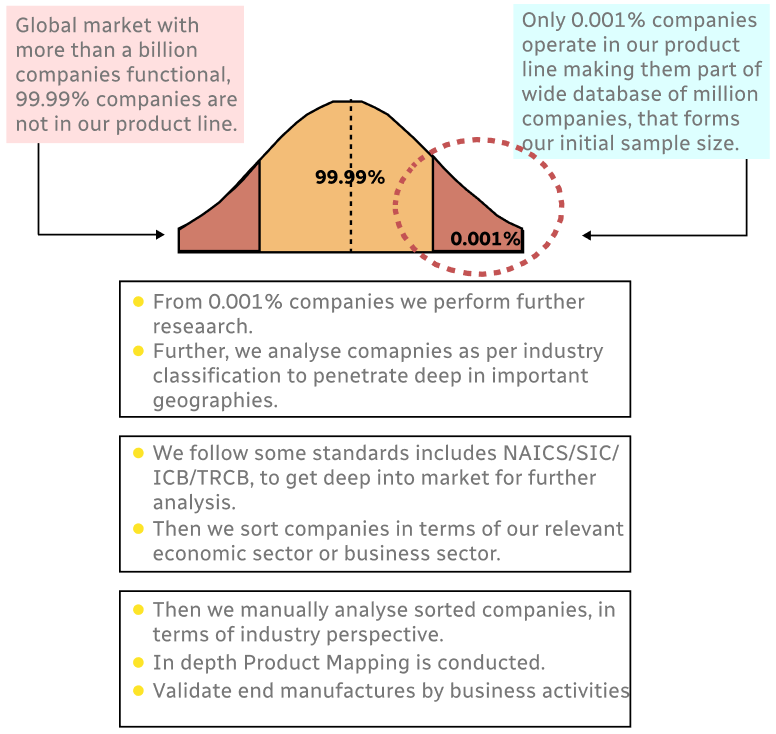
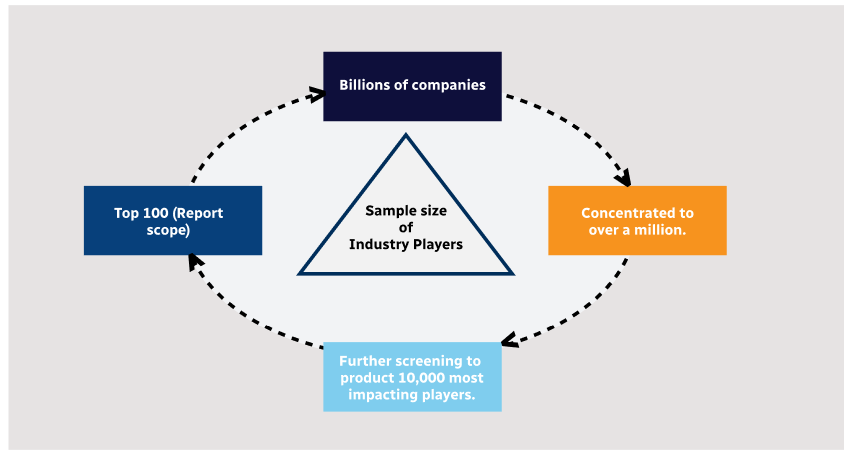
Step 1 - Identification of Relevant Samples Size from Population Database
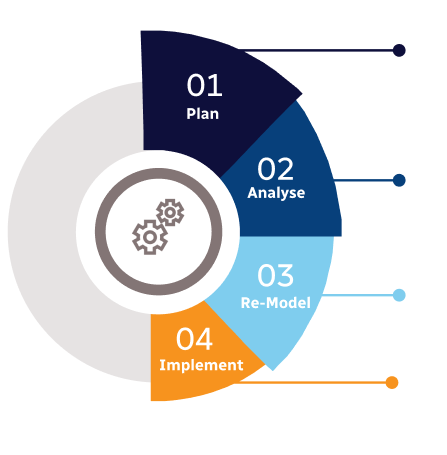
Step 2 - Approaches for Defining Global Market Size (Value, Volume* & Price*)
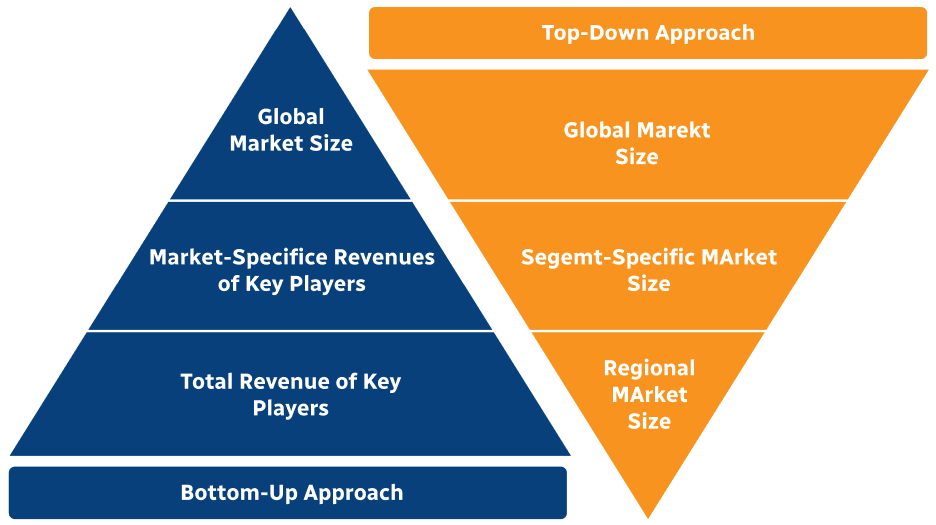
Note*: In applicable scenarios
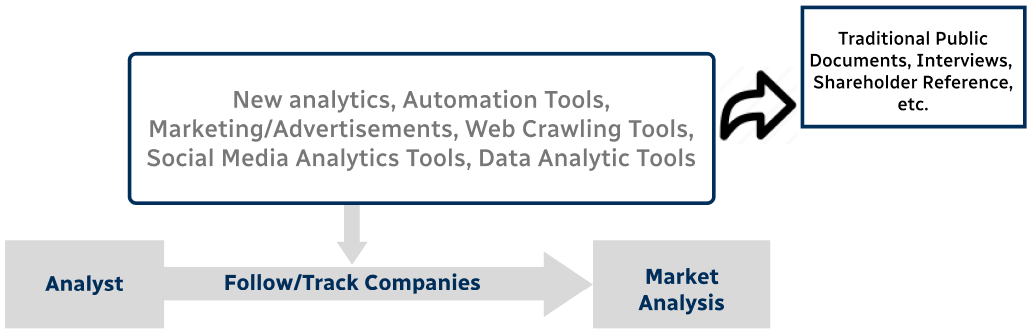
Step 3 - Data Sources
Primary Research
- Web Analytics
- Survey Reports
- Research Institute
- Latest Research Reports
- Opinion Leaders
Secondary Research
- Annual Reports
- White Paper
- Latest Press Release
- Industry Association
- Paid Database
- Investor Presentations
Step 4 - Data Triangulation
Involves using different sources of information in order to increase the validity of a study
These sources are likely to be stakeholders in a program - participants, other researchers, program staff, other community members, and so on.
Then we put all data in single framework & apply various statistical tools to find out the dynamic on the market.
During the analysis stage, feedback from the stakeholder groups would be compared to determine areas of agreement as well as areas of divergence