Key Insights
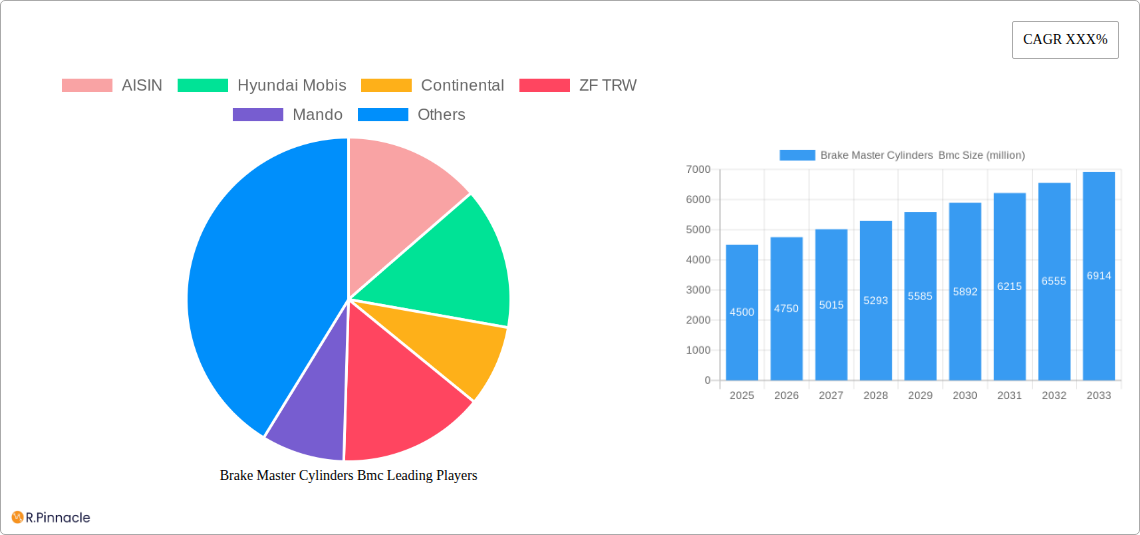
The global Brake Master Cylinders (BMC) market is poised for significant expansion, projected to reach an estimated market size of USD 4,500 million by 2025. This growth is fueled by a confluence of factors, including the increasing global vehicle production, particularly in the passenger vehicle segment, and the continuous technological advancements in automotive safety systems. The market is expected to witness a Compound Annual Growth Rate (CAGR) of approximately 5.5% between 2025 and 2033, indicating a robust and sustained upward trajectory. Key drivers for this expansion include the growing demand for advanced braking systems, such as Anti-lock Braking Systems (ABS) and Electronic Stability Control (ESC), which inherently rely on sophisticated master cylinder technology. Furthermore, the rising average age of the vehicle fleet in mature markets necessitates more frequent replacement of components, including brake master cylinders, thereby contributing to market volume. Emerging economies, with their burgeoning automotive sectors and increasing disposable incomes, represent a substantial opportunity for market penetration and growth.
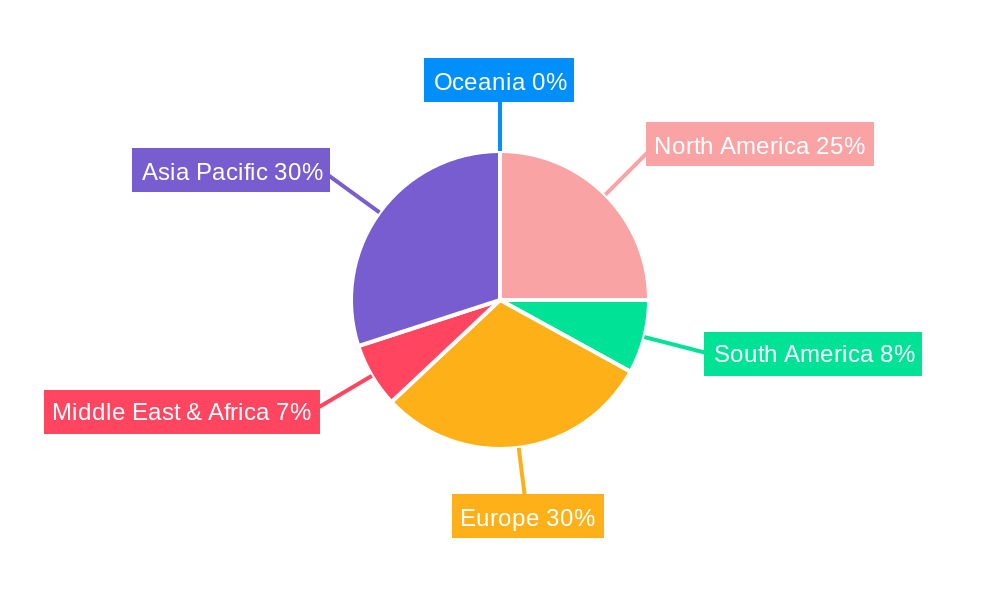
The market segmentation reveals a clear dominance of the Passenger Vehicle application segment, driven by higher production volumes compared to commercial vehicles. Within the product types, Dual-Cylinder Master Cylinders are likely to hold a larger market share due to their superior safety and performance characteristics, offering redundancy in case of a primary system failure. However, Single-Cylinder Master Cylinders will continue to find application in certain cost-sensitive segments and older vehicle models. Geographically, Asia Pacific, led by China and India, is expected to be the fastest-growing region, owing to its massive vehicle manufacturing base and increasing adoption of advanced automotive technologies. North America and Europe, while mature markets, will continue to contribute significantly to the market value due to stringent safety regulations and a high proportion of advanced braking systems in their vehicle fleets. Restraints such as the potential for market saturation in certain developed regions and the development of entirely new braking technologies that might bypass traditional master cylinders could pose challenges. However, the overall outlook remains strongly positive, supported by ongoing innovation and the critical safety role of brake master cylinders.
Brake Master Cylinders Bmc Market: Comprehensive Industry Analysis 2019–2033
This in-depth market research report provides a detailed analysis of the global Brake Master Cylinders (BMC) market from 2019 to 2033, with a base year of 2025. It offers critical insights into market structure, dynamics, regional dominance, product innovations, growth drivers, challenges, emerging opportunities, leading players, and key industry developments. Leveraging a wealth of data and expert analysis, this report is essential for automotive manufacturers, component suppliers, investors, and industry stakeholders seeking to understand and capitalize on the evolving BMC landscape. The study period encompasses historical data from 2019–2024, with a forecast period extending from 2025–2033.
Brake Master Cylinders Bmc Market Structure & Innovation Trends
The global Brake Master Cylinders (BMC) market exhibits a moderately concentrated structure, with key players like AISIN, Hyundai Mobis, Continental, ZF TRW, Mando, and Bosch dominating significant market share. Innovation is a primary driver, fueled by advancements in vehicle safety technologies, including Electronic Stability Control (ESC) and Anti-lock Braking Systems (ABS), which necessitate sophisticated BMC designs. Regulatory frameworks, such as stringent safety standards and emissions regulations, are continuously pushing for lighter, more efficient, and durable BMC solutions. Product substitutes, while limited in direct replacement for core function, include integrated braking systems and advanced mechatronic solutions that may evolve over time. End-user demographics are predominantly driven by the passenger vehicle segment, followed by the commercial vehicle sector, with a growing emphasis on electric and hybrid vehicles. Mergers and acquisitions (M&A) activity has been strategic, with deal values in the hundreds of millions to billions of dollars, aimed at consolidating market presence, expanding technological capabilities, and enhancing geographical reach. For instance, significant M&A deals in the automotive component sector have often involved players in braking systems, with estimated deal values reaching over $500 million in several instances.
Brake Master Cylinders Bmc Market Dynamics & Trends
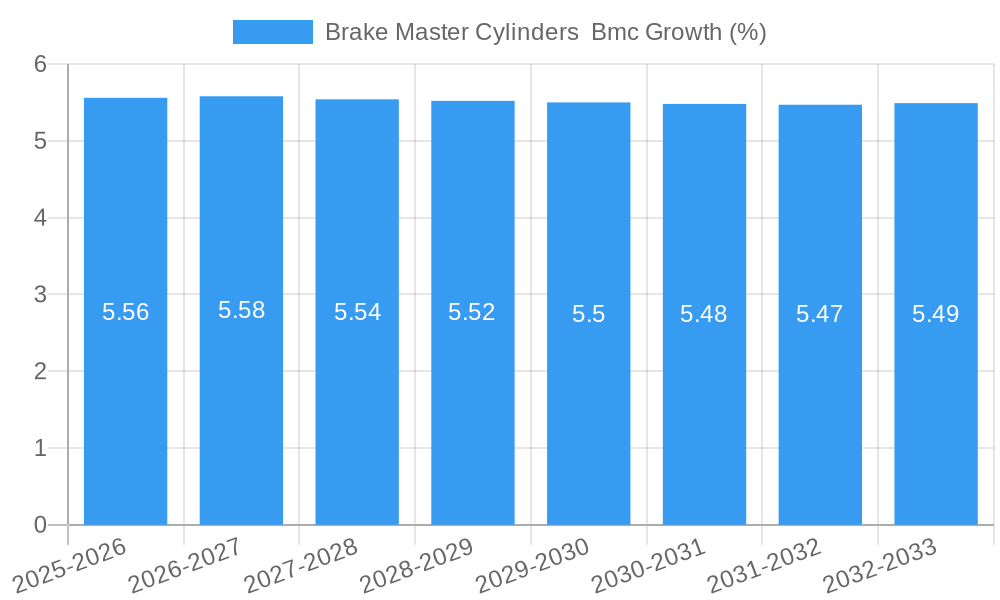
The Brake Master Cylinders (BMC) market is poised for robust growth, projected to achieve a Compound Annual Growth Rate (CAGR) of approximately 6.5% over the forecast period. This expansion is propelled by several interconnected market dynamics and trends. The increasing global automotive production, particularly in emerging economies, directly translates to a higher demand for BMCs. Furthermore, the escalating global adoption of advanced driver-assistance systems (ADAS) and the ongoing pursuit of enhanced vehicle safety are significant growth accelerators. Modern vehicles are increasingly equipped with sophisticated braking functionalities, requiring highly reliable and responsive BMCs. Technological disruptions are primarily centered on the integration of smart technologies and lightweight materials. Manufacturers are investing in research and development to create BMCs that are not only durable but also lighter, reducing overall vehicle weight and improving fuel efficiency, or extending the range of electric vehicles. The trend towards electromechanical and electro-hydraulic braking systems, which offer faster response times and greater precision, is also gaining momentum. Consumer preferences are shifting towards vehicles with superior safety features and advanced technological integration, indirectly driving the demand for high-performance BMCs. The competitive landscape is characterized by intense innovation and strategic partnerships, with companies vying to offer cost-effective, high-quality, and technologically advanced solutions. Market penetration of advanced BMC technologies is steadily increasing, especially in premium and mid-range vehicle segments. The increasing regulatory emphasis on vehicle safety and emissions standards acts as a significant catalyst, pushing OEMs to adopt more advanced braking systems that incorporate cutting-edge BMC technology. This sustained demand, coupled with technological advancements, ensures a dynamic and growing market for brake master cylinders.
Dominant Regions & Segments in Brake Master Cylinders Bmc
The Asia Pacific region is currently the dominant force in the global Brake Master Cylinders (BMC) market, driven by its status as the world's largest automotive manufacturing hub and a rapidly growing consumer base. Countries like China, Japan, South Korea, and India are key contributors to this dominance, benefiting from substantial investments in automotive production facilities and a burgeoning demand for both passenger and commercial vehicles. China, in particular, plays a pivotal role, accounting for a significant portion of global vehicle production and consumption.
- Key Drivers in Asia Pacific:
- Robust Automotive Production: The presence of major global automotive manufacturers and a thriving domestic automotive industry.
- Increasing Vehicle Ownership: Growing disposable incomes and urbanization leading to higher vehicle purchase rates.
- Government Support & Policies: Favorable government policies promoting manufacturing and automotive sector growth.
- Technological Adoption: Rapid adoption of advanced safety features and technologies in vehicles.
Within the Application segmentation, Passenger Vehicles represent the largest and fastest-growing segment. This is attributed to the sheer volume of passenger cars manufactured and sold globally, coupled with an increasing demand for enhanced safety features and comfort in everyday commuting. The growing middle class in emerging economies further fuels this segment's expansion.
The Commercial Vehicle segment, while smaller in volume, is also experiencing steady growth, driven by the expansion of logistics and transportation networks worldwide, and the increasing need for reliable braking systems in heavy-duty applications.
In terms of Type, Dual-Cylinder Master Cylinders hold the leading market share and are expected to continue their dominance. This is due to their inherent safety advantage, offering redundancy in case of a leak or failure in one cylinder, which is critical for meeting stringent safety regulations across most vehicle types.
- Dominance of Dual-Cylinder Master Cylinders:
- Enhanced Safety: Provides a critical safety backup, fulfilling regulatory requirements for fail-safe braking systems.
- Performance and Reliability: Offers superior braking performance and reliability compared to single-cylinder systems.
- Widespread Adoption: Standard on most modern passenger vehicles and commercial vehicles due to their safety benefits.
While Single-Cylinder Master Cylinders are still utilized in some lower-cost or specialized applications, their market share is diminishing as safety standards evolve. The Others category, encompassing specialized or integrated braking system components, is a nascent segment with potential for future growth as technology advances.
Brake Master Cylinders Bmc Product Innovations
Recent product innovations in the Brake Master Cylinders (BMC) market are focused on enhancing safety, efficiency, and integration. Manufacturers are developing lighter-weight BMCs using advanced aluminum alloys and composites to improve fuel economy and electric vehicle range. The integration of electronic control units (ECUs) within BMCs is enabling smarter braking systems, offering improved responsiveness and compatibility with ADAS features like automatic emergency braking and adaptive cruise control. Innovations are also geared towards improved sealing technologies and corrosion resistance for longer lifespan and reduced maintenance. These developments provide competitive advantages by meeting stringent OEM specifications and consumer demand for safer, more advanced vehicles.
Report Scope & Segmentation Analysis
This report provides a comprehensive analysis of the global Brake Master Cylinders (BMC) market, segmented by Application and Type. The Application segment is further categorized into Passenger Vehicle and Commercial Vehicle. The Passenger Vehicle segment, expected to exhibit a robust CAGR of approximately 7.0% from 2025 to 2033, is driven by increasing vehicle production and demand for advanced safety features. The Commercial Vehicle segment, with a projected CAGR of around 5.5%, is fueled by expanding logistics and infrastructure development. The Type segment includes Single-Cylinder Master Cylinders and Dual-Cylinder Master Cylinders, alongside an Others category. Dual-Cylinder Master Cylinders currently dominate the market and are projected to maintain their lead due to their inherent safety advantages and widespread adoption across vehicle types, holding an estimated market share exceeding 70% by 2025.
Key Drivers of Brake Master Cylinders Bmc Growth
The growth of the Brake Master Cylinders (BMC) market is primarily driven by several key factors. The continuous increase in global automotive production, particularly in emerging economies, directly boosts demand for BMC components. Furthermore, the escalating adoption of Advanced Driver-Assistance Systems (ADAS) and the unwavering focus on vehicle safety worldwide necessitate the use of sophisticated and reliable braking systems, including advanced BMCs. Stringent government regulations mandating enhanced safety features in vehicles also act as a significant catalyst. Technological advancements, such as the development of lighter materials and integrated electronic controls, are pushing innovation and creating a demand for next-generation BMCs.
Challenges in the Brake Master Cylinders Bmc Sector
Despite the positive growth trajectory, the Brake Master Cylinders (BMC) sector faces several challenges. Intense competition among established players and new entrants exerts downward pressure on pricing and profit margins. Supply chain disruptions, exacerbated by geopolitical factors and raw material price volatility, can impact production costs and lead times. Evolving technological landscapes, particularly the rapid advancements in alternative braking technologies, pose a long-term threat and require continuous investment in R&D to remain competitive. Additionally, the increasing complexity of vehicle electronics and the integration of braking systems with other vehicle functions demand specialized expertise and significant capital investment from BMC manufacturers.
Emerging Opportunities in Brake Master Cylinders Bmc
Several emerging opportunities are poised to shape the future of the Brake Master Cylinders (BMC) market. The burgeoning electric vehicle (EV) market presents a significant opportunity, as EVs often require specialized regenerative braking systems that can be integrated with or complement traditional hydraulic braking, creating demand for novel BMC designs. The growing demand for autonomous driving technologies will further drive innovation in highly precise and responsive braking systems. Expansion into untapped or underserved emerging markets in regions like Southeast Asia and parts of Africa offers substantial growth potential. Moreover, strategic collaborations and partnerships between BMC manufacturers and automotive OEMs can accelerate the development and adoption of cutting-edge technologies.
Leading Players in the Brake Master Cylinders Bmc Market
- AISIN
- Hyundai Mobis
- Continental
- ZF TRW
- Mando
- Bosch
- HUAYU
- Nissin Kogyo
- Hitachi Automotive
- FTE Automotive (Valeo)
- Dongguang Aowei(Northeast Industries)
- Wanxiang
- Hella Pagid
- Zhejiang Jingke
- Zhejiang VIE
- BWI Group
- Wuhu Bethel
- CARDONE
- Liuzhou Wuling
- YULIAN
Key Developments in Brake Master Cylinders Bmc Industry
- 2023 (Q4): Continental AG announced advancements in their integrated brake systems, enhancing performance for ADAS functionalities.
- 2023 (Q3): ZF TRW launched a new generation of lightweight BMCs for passenger vehicles, focusing on fuel efficiency.
- 2023 (Q2): AISIN expanded its production capacity for dual-cylinder master cylinders in Southeast Asia to meet growing regional demand.
- 2022 (Q4): Hyundai Mobis invested in R&D for electromechanical braking systems, signaling a shift towards advanced technologies.
- 2022 (Q3): Mando acquired a stake in a technology firm specializing in intelligent braking solutions, strengthening its innovation pipeline.
- 2022 (Q2): Bosch introduced an innovative BMC design that significantly reduces system complexity and manufacturing costs.
- 2021 (Q4): HUAYU expanded its market reach through strategic distribution agreements in emerging markets.
- 2021 (Q3): Nissin Kogyo partnered with an EV manufacturer to develop custom BMC solutions for electric platforms.
- 2021 (Q2): FTE Automotive (Valeo) focused on enhancing the durability and longevity of their BMC offerings.
- 2020 (Q4): Dongguang Aowei strengthened its domestic market position with new product launches.
- 2020 (Q3): Wanxiang continued its expansion in the commercial vehicle braking systems sector.
Future Outlook for Brake Master Cylinders Bmc Market
The future outlook for the Brake Master Cylinders (BMC) market is highly optimistic, driven by the relentless evolution of the automotive industry. The accelerating transition towards electric and autonomous vehicles will necessitate highly sophisticated, integrated, and responsive braking systems, creating substantial opportunities for innovative BMC designs. Continued global economic recovery and increasing vehicle parc in developing regions will further fuel demand. Strategic investments in R&D, focusing on smart technologies, lightweight materials, and improved manufacturing processes, will be crucial for market leaders to maintain their competitive edge. The emphasis on enhanced vehicle safety and adherence to evolving global regulations will continue to be a primary growth accelerator, ensuring a robust and dynamic market for brake master cylinders for the foreseeable future.
Brake Master Cylinders Bmc Segmentation
-
1. Application
- 1.1. Passenger Vehicle
- 1.2. Commercial Vehicle
-
2. Type
- 2.1. Single-Cylinder Master Cylinders
- 2.2. Dual-Cylinder Master Cylinders
- 2.3. Others
Brake Master Cylinders Bmc Segmentation By Geography
-
1. North America
- 1.1. United States
- 1.2. Canada
- 1.3. Mexico
-
2. South America
- 2.1. Brazil
- 2.2. Argentina
- 2.3. Rest of South America
-
3. Europe
- 3.1. United Kingdom
- 3.2. Germany
- 3.3. France
- 3.4. Italy
- 3.5. Spain
- 3.6. Russia
- 3.7. Benelux
- 3.8. Nordics
- 3.9. Rest of Europe
-
4. Middle East & Africa
- 4.1. Turkey
- 4.2. Israel
- 4.3. GCC
- 4.4. North Africa
- 4.5. South Africa
- 4.6. Rest of Middle East & Africa
-
5. Asia Pacific
- 5.1. China
- 5.2. India
- 5.3. Japan
- 5.4. South Korea
- 5.5. ASEAN
- 5.6. Oceania
- 5.7. Rest of Asia Pacific
Brake Master Cylinders Bmc REPORT HIGHLIGHTS
| Aspects | Details |
|---|---|
| Study Period | 2019-2033 |
| Base Year | 2024 |
| Estimated Year | 2025 |
| Forecast Period | 2025-2033 |
| Historical Period | 2019-2024 |
| Growth Rate | CAGR of XXX% from 2019-2033 |
| Segmentation |
|
Table of Contents
- 1. Introduction
- 1.1. Research Scope
- 1.2. Market Segmentation
- 1.3. Research Methodology
- 1.4. Definitions and Assumptions
- 2. Executive Summary
- 2.1. Introduction
- 3. Market Dynamics
- 3.1. Introduction
- 3.2. Market Drivers
- 3.3. Market Restrains
- 3.4. Market Trends
- 4. Market Factor Analysis
- 4.1. Porters Five Forces
- 4.2. Supply/Value Chain
- 4.3. PESTEL analysis
- 4.4. Market Entropy
- 4.5. Patent/Trademark Analysis
- 5. Global Brake Master Cylinders Bmc Analysis, Insights and Forecast, 2019-2031
- 5.1. Market Analysis, Insights and Forecast - by Application
- 5.1.1. Passenger Vehicle
- 5.1.2. Commercial Vehicle
- 5.2. Market Analysis, Insights and Forecast - by Type
- 5.2.1. Single-Cylinder Master Cylinders
- 5.2.2. Dual-Cylinder Master Cylinders
- 5.2.3. Others
- 5.3. Market Analysis, Insights and Forecast - by Region
- 5.3.1. North America
- 5.3.2. South America
- 5.3.3. Europe
- 5.3.4. Middle East & Africa
- 5.3.5. Asia Pacific
- 5.1. Market Analysis, Insights and Forecast - by Application
- 6. North America Brake Master Cylinders Bmc Analysis, Insights and Forecast, 2019-2031
- 6.1. Market Analysis, Insights and Forecast - by Application
- 6.1.1. Passenger Vehicle
- 6.1.2. Commercial Vehicle
- 6.2. Market Analysis, Insights and Forecast - by Type
- 6.2.1. Single-Cylinder Master Cylinders
- 6.2.2. Dual-Cylinder Master Cylinders
- 6.2.3. Others
- 6.1. Market Analysis, Insights and Forecast - by Application
- 7. South America Brake Master Cylinders Bmc Analysis, Insights and Forecast, 2019-2031
- 7.1. Market Analysis, Insights and Forecast - by Application
- 7.1.1. Passenger Vehicle
- 7.1.2. Commercial Vehicle
- 7.2. Market Analysis, Insights and Forecast - by Type
- 7.2.1. Single-Cylinder Master Cylinders
- 7.2.2. Dual-Cylinder Master Cylinders
- 7.2.3. Others
- 7.1. Market Analysis, Insights and Forecast - by Application
- 8. Europe Brake Master Cylinders Bmc Analysis, Insights and Forecast, 2019-2031
- 8.1. Market Analysis, Insights and Forecast - by Application
- 8.1.1. Passenger Vehicle
- 8.1.2. Commercial Vehicle
- 8.2. Market Analysis, Insights and Forecast - by Type
- 8.2.1. Single-Cylinder Master Cylinders
- 8.2.2. Dual-Cylinder Master Cylinders
- 8.2.3. Others
- 8.1. Market Analysis, Insights and Forecast - by Application
- 9. Middle East & Africa Brake Master Cylinders Bmc Analysis, Insights and Forecast, 2019-2031
- 9.1. Market Analysis, Insights and Forecast - by Application
- 9.1.1. Passenger Vehicle
- 9.1.2. Commercial Vehicle
- 9.2. Market Analysis, Insights and Forecast - by Type
- 9.2.1. Single-Cylinder Master Cylinders
- 9.2.2. Dual-Cylinder Master Cylinders
- 9.2.3. Others
- 9.1. Market Analysis, Insights and Forecast - by Application
- 10. Asia Pacific Brake Master Cylinders Bmc Analysis, Insights and Forecast, 2019-2031
- 10.1. Market Analysis, Insights and Forecast - by Application
- 10.1.1. Passenger Vehicle
- 10.1.2. Commercial Vehicle
- 10.2. Market Analysis, Insights and Forecast - by Type
- 10.2.1. Single-Cylinder Master Cylinders
- 10.2.2. Dual-Cylinder Master Cylinders
- 10.2.3. Others
- 10.1. Market Analysis, Insights and Forecast - by Application
- 11. Competitive Analysis
- 11.1. Global Market Share Analysis 2024
- 11.2. Company Profiles
- 11.2.1 AISIN
- 11.2.1.1. Overview
- 11.2.1.2. Products
- 11.2.1.3. SWOT Analysis
- 11.2.1.4. Recent Developments
- 11.2.1.5. Financials (Based on Availability)
- 11.2.2 Hyundai Mobis
- 11.2.2.1. Overview
- 11.2.2.2. Products
- 11.2.2.3. SWOT Analysis
- 11.2.2.4. Recent Developments
- 11.2.2.5. Financials (Based on Availability)
- 11.2.3 Continental
- 11.2.3.1. Overview
- 11.2.3.2. Products
- 11.2.3.3. SWOT Analysis
- 11.2.3.4. Recent Developments
- 11.2.3.5. Financials (Based on Availability)
- 11.2.4 ZF TRW
- 11.2.4.1. Overview
- 11.2.4.2. Products
- 11.2.4.3. SWOT Analysis
- 11.2.4.4. Recent Developments
- 11.2.4.5. Financials (Based on Availability)
- 11.2.5 Mando
- 11.2.5.1. Overview
- 11.2.5.2. Products
- 11.2.5.3. SWOT Analysis
- 11.2.5.4. Recent Developments
- 11.2.5.5. Financials (Based on Availability)
- 11.2.6 Bosch
- 11.2.6.1. Overview
- 11.2.6.2. Products
- 11.2.6.3. SWOT Analysis
- 11.2.6.4. Recent Developments
- 11.2.6.5. Financials (Based on Availability)
- 11.2.7 HUAYU
- 11.2.7.1. Overview
- 11.2.7.2. Products
- 11.2.7.3. SWOT Analysis
- 11.2.7.4. Recent Developments
- 11.2.7.5. Financials (Based on Availability)
- 11.2.8 Nissin Kogyo
- 11.2.8.1. Overview
- 11.2.8.2. Products
- 11.2.8.3. SWOT Analysis
- 11.2.8.4. Recent Developments
- 11.2.8.5. Financials (Based on Availability)
- 11.2.9 Hitachi Automotive
- 11.2.9.1. Overview
- 11.2.9.2. Products
- 11.2.9.3. SWOT Analysis
- 11.2.9.4. Recent Developments
- 11.2.9.5. Financials (Based on Availability)
- 11.2.10 FTE Automotive (Valeo)
- 11.2.10.1. Overview
- 11.2.10.2. Products
- 11.2.10.3. SWOT Analysis
- 11.2.10.4. Recent Developments
- 11.2.10.5. Financials (Based on Availability)
- 11.2.11 Dongguang Aowei(Northeast Industries)
- 11.2.11.1. Overview
- 11.2.11.2. Products
- 11.2.11.3. SWOT Analysis
- 11.2.11.4. Recent Developments
- 11.2.11.5. Financials (Based on Availability)
- 11.2.12 Wanxiang
- 11.2.12.1. Overview
- 11.2.12.2. Products
- 11.2.12.3. SWOT Analysis
- 11.2.12.4. Recent Developments
- 11.2.12.5. Financials (Based on Availability)
- 11.2.13 Hella Pagid
- 11.2.13.1. Overview
- 11.2.13.2. Products
- 11.2.13.3. SWOT Analysis
- 11.2.13.4. Recent Developments
- 11.2.13.5. Financials (Based on Availability)
- 11.2.14 Zhejiang Jingke
- 11.2.14.1. Overview
- 11.2.14.2. Products
- 11.2.14.3. SWOT Analysis
- 11.2.14.4. Recent Developments
- 11.2.14.5. Financials (Based on Availability)
- 11.2.15 Zhejiang VIE
- 11.2.15.1. Overview
- 11.2.15.2. Products
- 11.2.15.3. SWOT Analysis
- 11.2.15.4. Recent Developments
- 11.2.15.5. Financials (Based on Availability)
- 11.2.16 BWI Group
- 11.2.16.1. Overview
- 11.2.16.2. Products
- 11.2.16.3. SWOT Analysis
- 11.2.16.4. Recent Developments
- 11.2.16.5. Financials (Based on Availability)
- 11.2.17 Wuhu Bethel
- 11.2.17.1. Overview
- 11.2.17.2. Products
- 11.2.17.3. SWOT Analysis
- 11.2.17.4. Recent Developments
- 11.2.17.5. Financials (Based on Availability)
- 11.2.18 CARDONE
- 11.2.18.1. Overview
- 11.2.18.2. Products
- 11.2.18.3. SWOT Analysis
- 11.2.18.4. Recent Developments
- 11.2.18.5. Financials (Based on Availability)
- 11.2.19 Liuzhou Wuling
- 11.2.19.1. Overview
- 11.2.19.2. Products
- 11.2.19.3. SWOT Analysis
- 11.2.19.4. Recent Developments
- 11.2.19.5. Financials (Based on Availability)
- 11.2.20 YULIAN
- 11.2.20.1. Overview
- 11.2.20.2. Products
- 11.2.20.3. SWOT Analysis
- 11.2.20.4. Recent Developments
- 11.2.20.5. Financials (Based on Availability)
- 11.2.1 AISIN
List of Figures
- Figure 1: Global Brake Master Cylinders Bmc Revenue Breakdown (million, %) by Region 2024 & 2032
- Figure 2: North America Brake Master Cylinders Bmc Revenue (million), by Application 2024 & 2032
- Figure 3: North America Brake Master Cylinders Bmc Revenue Share (%), by Application 2024 & 2032
- Figure 4: North America Brake Master Cylinders Bmc Revenue (million), by Type 2024 & 2032
- Figure 5: North America Brake Master Cylinders Bmc Revenue Share (%), by Type 2024 & 2032
- Figure 6: North America Brake Master Cylinders Bmc Revenue (million), by Country 2024 & 2032
- Figure 7: North America Brake Master Cylinders Bmc Revenue Share (%), by Country 2024 & 2032
- Figure 8: South America Brake Master Cylinders Bmc Revenue (million), by Application 2024 & 2032
- Figure 9: South America Brake Master Cylinders Bmc Revenue Share (%), by Application 2024 & 2032
- Figure 10: South America Brake Master Cylinders Bmc Revenue (million), by Type 2024 & 2032
- Figure 11: South America Brake Master Cylinders Bmc Revenue Share (%), by Type 2024 & 2032
- Figure 12: South America Brake Master Cylinders Bmc Revenue (million), by Country 2024 & 2032
- Figure 13: South America Brake Master Cylinders Bmc Revenue Share (%), by Country 2024 & 2032
- Figure 14: Europe Brake Master Cylinders Bmc Revenue (million), by Application 2024 & 2032
- Figure 15: Europe Brake Master Cylinders Bmc Revenue Share (%), by Application 2024 & 2032
- Figure 16: Europe Brake Master Cylinders Bmc Revenue (million), by Type 2024 & 2032
- Figure 17: Europe Brake Master Cylinders Bmc Revenue Share (%), by Type 2024 & 2032
- Figure 18: Europe Brake Master Cylinders Bmc Revenue (million), by Country 2024 & 2032
- Figure 19: Europe Brake Master Cylinders Bmc Revenue Share (%), by Country 2024 & 2032
- Figure 20: Middle East & Africa Brake Master Cylinders Bmc Revenue (million), by Application 2024 & 2032
- Figure 21: Middle East & Africa Brake Master Cylinders Bmc Revenue Share (%), by Application 2024 & 2032
- Figure 22: Middle East & Africa Brake Master Cylinders Bmc Revenue (million), by Type 2024 & 2032
- Figure 23: Middle East & Africa Brake Master Cylinders Bmc Revenue Share (%), by Type 2024 & 2032
- Figure 24: Middle East & Africa Brake Master Cylinders Bmc Revenue (million), by Country 2024 & 2032
- Figure 25: Middle East & Africa Brake Master Cylinders Bmc Revenue Share (%), by Country 2024 & 2032
- Figure 26: Asia Pacific Brake Master Cylinders Bmc Revenue (million), by Application 2024 & 2032
- Figure 27: Asia Pacific Brake Master Cylinders Bmc Revenue Share (%), by Application 2024 & 2032
- Figure 28: Asia Pacific Brake Master Cylinders Bmc Revenue (million), by Type 2024 & 2032
- Figure 29: Asia Pacific Brake Master Cylinders Bmc Revenue Share (%), by Type 2024 & 2032
- Figure 30: Asia Pacific Brake Master Cylinders Bmc Revenue (million), by Country 2024 & 2032
- Figure 31: Asia Pacific Brake Master Cylinders Bmc Revenue Share (%), by Country 2024 & 2032
List of Tables
- Table 1: Global Brake Master Cylinders Bmc Revenue million Forecast, by Region 2019 & 2032
- Table 2: Global Brake Master Cylinders Bmc Revenue million Forecast, by Application 2019 & 2032
- Table 3: Global Brake Master Cylinders Bmc Revenue million Forecast, by Type 2019 & 2032
- Table 4: Global Brake Master Cylinders Bmc Revenue million Forecast, by Region 2019 & 2032
- Table 5: Global Brake Master Cylinders Bmc Revenue million Forecast, by Application 2019 & 2032
- Table 6: Global Brake Master Cylinders Bmc Revenue million Forecast, by Type 2019 & 2032
- Table 7: Global Brake Master Cylinders Bmc Revenue million Forecast, by Country 2019 & 2032
- Table 8: United States Brake Master Cylinders Bmc Revenue (million) Forecast, by Application 2019 & 2032
- Table 9: Canada Brake Master Cylinders Bmc Revenue (million) Forecast, by Application 2019 & 2032
- Table 10: Mexico Brake Master Cylinders Bmc Revenue (million) Forecast, by Application 2019 & 2032
- Table 11: Global Brake Master Cylinders Bmc Revenue million Forecast, by Application 2019 & 2032
- Table 12: Global Brake Master Cylinders Bmc Revenue million Forecast, by Type 2019 & 2032
- Table 13: Global Brake Master Cylinders Bmc Revenue million Forecast, by Country 2019 & 2032
- Table 14: Brazil Brake Master Cylinders Bmc Revenue (million) Forecast, by Application 2019 & 2032
- Table 15: Argentina Brake Master Cylinders Bmc Revenue (million) Forecast, by Application 2019 & 2032
- Table 16: Rest of South America Brake Master Cylinders Bmc Revenue (million) Forecast, by Application 2019 & 2032
- Table 17: Global Brake Master Cylinders Bmc Revenue million Forecast, by Application 2019 & 2032
- Table 18: Global Brake Master Cylinders Bmc Revenue million Forecast, by Type 2019 & 2032
- Table 19: Global Brake Master Cylinders Bmc Revenue million Forecast, by Country 2019 & 2032
- Table 20: United Kingdom Brake Master Cylinders Bmc Revenue (million) Forecast, by Application 2019 & 2032
- Table 21: Germany Brake Master Cylinders Bmc Revenue (million) Forecast, by Application 2019 & 2032
- Table 22: France Brake Master Cylinders Bmc Revenue (million) Forecast, by Application 2019 & 2032
- Table 23: Italy Brake Master Cylinders Bmc Revenue (million) Forecast, by Application 2019 & 2032
- Table 24: Spain Brake Master Cylinders Bmc Revenue (million) Forecast, by Application 2019 & 2032
- Table 25: Russia Brake Master Cylinders Bmc Revenue (million) Forecast, by Application 2019 & 2032
- Table 26: Benelux Brake Master Cylinders Bmc Revenue (million) Forecast, by Application 2019 & 2032
- Table 27: Nordics Brake Master Cylinders Bmc Revenue (million) Forecast, by Application 2019 & 2032
- Table 28: Rest of Europe Brake Master Cylinders Bmc Revenue (million) Forecast, by Application 2019 & 2032
- Table 29: Global Brake Master Cylinders Bmc Revenue million Forecast, by Application 2019 & 2032
- Table 30: Global Brake Master Cylinders Bmc Revenue million Forecast, by Type 2019 & 2032
- Table 31: Global Brake Master Cylinders Bmc Revenue million Forecast, by Country 2019 & 2032
- Table 32: Turkey Brake Master Cylinders Bmc Revenue (million) Forecast, by Application 2019 & 2032
- Table 33: Israel Brake Master Cylinders Bmc Revenue (million) Forecast, by Application 2019 & 2032
- Table 34: GCC Brake Master Cylinders Bmc Revenue (million) Forecast, by Application 2019 & 2032
- Table 35: North Africa Brake Master Cylinders Bmc Revenue (million) Forecast, by Application 2019 & 2032
- Table 36: South Africa Brake Master Cylinders Bmc Revenue (million) Forecast, by Application 2019 & 2032
- Table 37: Rest of Middle East & Africa Brake Master Cylinders Bmc Revenue (million) Forecast, by Application 2019 & 2032
- Table 38: Global Brake Master Cylinders Bmc Revenue million Forecast, by Application 2019 & 2032
- Table 39: Global Brake Master Cylinders Bmc Revenue million Forecast, by Type 2019 & 2032
- Table 40: Global Brake Master Cylinders Bmc Revenue million Forecast, by Country 2019 & 2032
- Table 41: China Brake Master Cylinders Bmc Revenue (million) Forecast, by Application 2019 & 2032
- Table 42: India Brake Master Cylinders Bmc Revenue (million) Forecast, by Application 2019 & 2032
- Table 43: Japan Brake Master Cylinders Bmc Revenue (million) Forecast, by Application 2019 & 2032
- Table 44: South Korea Brake Master Cylinders Bmc Revenue (million) Forecast, by Application 2019 & 2032
- Table 45: ASEAN Brake Master Cylinders Bmc Revenue (million) Forecast, by Application 2019 & 2032
- Table 46: Oceania Brake Master Cylinders Bmc Revenue (million) Forecast, by Application 2019 & 2032
- Table 47: Rest of Asia Pacific Brake Master Cylinders Bmc Revenue (million) Forecast, by Application 2019 & 2032
Frequently Asked Questions
1. What is the projected Compound Annual Growth Rate (CAGR) of the Brake Master Cylinders Bmc?
The projected CAGR is approximately XXX%.
2. Which companies are prominent players in the Brake Master Cylinders Bmc?
Key companies in the market include AISIN, Hyundai Mobis, Continental, ZF TRW, Mando, Bosch, HUAYU, Nissin Kogyo, Hitachi Automotive, FTE Automotive (Valeo), Dongguang Aowei(Northeast Industries), Wanxiang, Hella Pagid, Zhejiang Jingke, Zhejiang VIE, BWI Group, Wuhu Bethel, CARDONE, Liuzhou Wuling, YULIAN.
3. What are the main segments of the Brake Master Cylinders Bmc?
The market segments include Application, Type.
4. Can you provide details about the market size?
The market size is estimated to be USD XXX million as of 2022.
5. What are some drivers contributing to market growth?
N/A
6. What are the notable trends driving market growth?
N/A
7. Are there any restraints impacting market growth?
N/A
8. Can you provide examples of recent developments in the market?
N/A
9. What pricing options are available for accessing the report?
Pricing options include single-user, multi-user, and enterprise licenses priced at USD 2900.00, USD 4350.00, and USD 5800.00 respectively.
10. Is the market size provided in terms of value or volume?
The market size is provided in terms of value, measured in million.
11. Are there any specific market keywords associated with the report?
Yes, the market keyword associated with the report is "Brake Master Cylinders Bmc," which aids in identifying and referencing the specific market segment covered.
12. How do I determine which pricing option suits my needs best?
The pricing options vary based on user requirements and access needs. Individual users may opt for single-user licenses, while businesses requiring broader access may choose multi-user or enterprise licenses for cost-effective access to the report.
13. Are there any additional resources or data provided in the Brake Master Cylinders Bmc report?
While the report offers comprehensive insights, it's advisable to review the specific contents or supplementary materials provided to ascertain if additional resources or data are available.
14. How can I stay updated on further developments or reports in the Brake Master Cylinders Bmc?
To stay informed about further developments, trends, and reports in the Brake Master Cylinders Bmc, consider subscribing to industry newsletters, following relevant companies and organizations, or regularly checking reputable industry news sources and publications.
Methodology
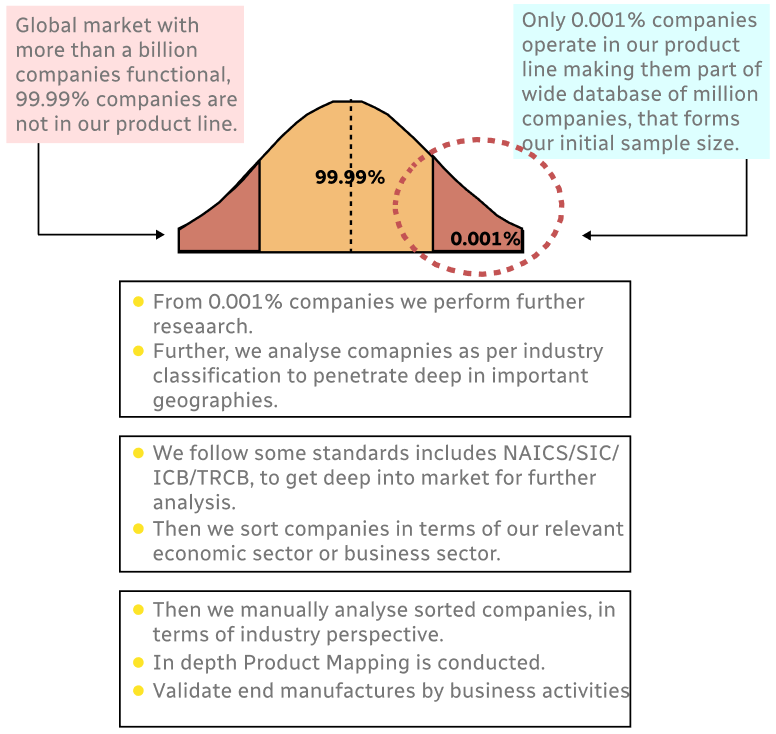
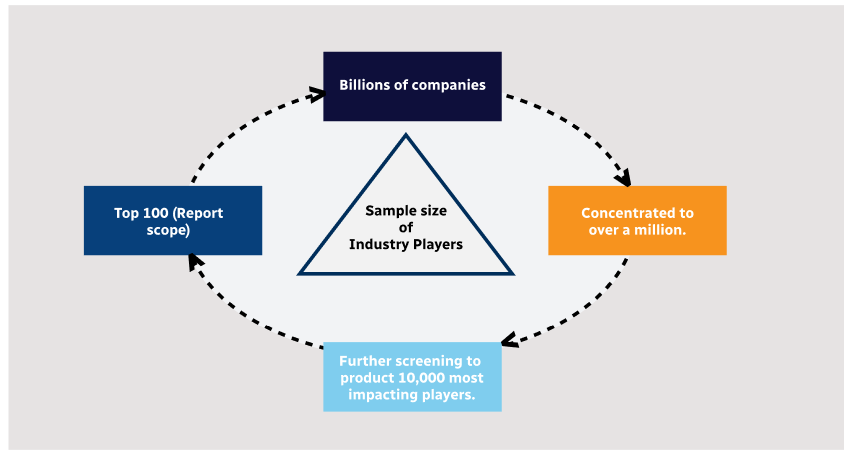
Step 1 - Identification of Relevant Samples Size from Population Database
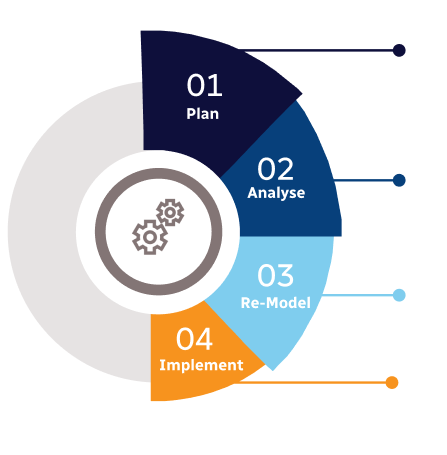
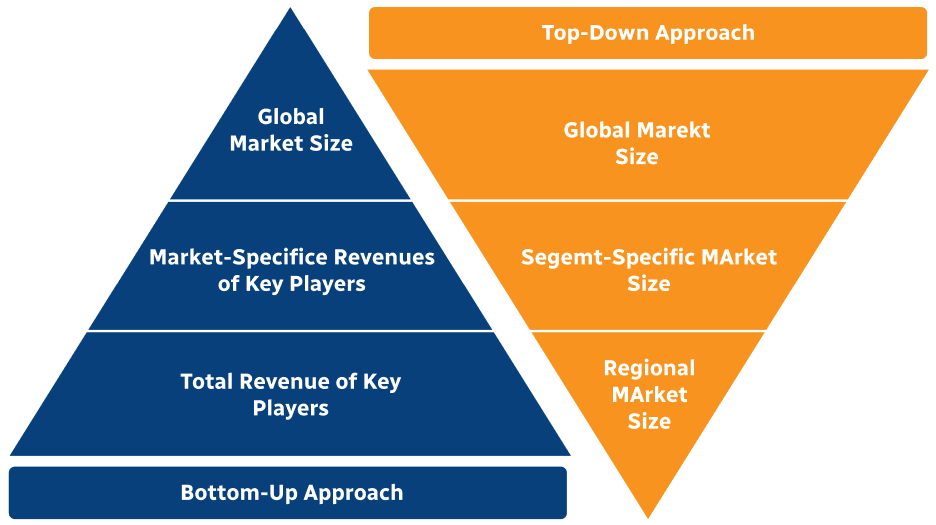
Step 2 - Approaches for Defining Global Market Size (Value, Volume* & Price*)
Note*: In applicable scenarios
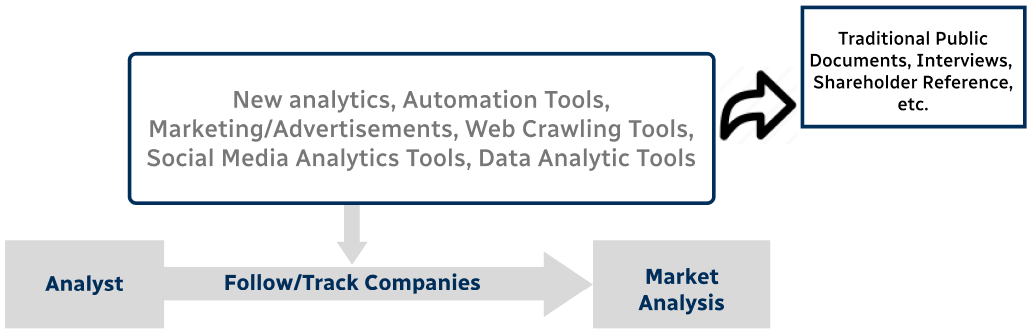
Step 3 - Data Sources
Primary Research
- Web Analytics
- Survey Reports
- Research Institute
- Latest Research Reports
- Opinion Leaders
Secondary Research
- Annual Reports
- White Paper
- Latest Press Release
- Industry Association
- Paid Database
- Investor Presentations
Step 4 - Data Triangulation
Involves using different sources of information in order to increase the validity of a study
These sources are likely to be stakeholders in a program - participants, other researchers, program staff, other community members, and so on.
Then we put all data in single framework & apply various statistical tools to find out the dynamic on the market.
During the analysis stage, feedback from the stakeholder groups would be compared to determine areas of agreement as well as areas of divergence